
AI blog writing tools have fundamentally changed how content marketers and bloggers approach search engine optimization. Instead of spending hours researching keywords, structuring outlines, and drafting first versions manually, an AI content generator can accelerate each of those steps while maintaining quality. But speed alone isn't the point.
The real value lies in how AI writing software helps you produce SEO blog posts that rank higher, attract more organic traffic, and convert readers into subscribers or customers. This guide walks you through four practical steps for using these tools effectively. Whether you're a solo blogger or managing a content team, you'll leave with a repeatable process that pairs AI efficiency with human editorial judgment.
Key Takeaways
- AI writing tools accelerate keyword research, outlining, drafting, and on-page SEO optimization significantly.
- Human editing remains essential for accuracy, brand voice, and genuine expertise in every post.
- Structured prompts produce dramatically better AI output than vague, one-line instructions.
- AI-assisted internal linking and metadata improve crawlability and click-through rates measurably.
- Consistent workflows combining AI drafting with human review outperform either approach used alone.

Step 1: Use AI for Keyword Research and Topic Clustering
Before you write a single sentence, you need to know what your audience is actually searching for. AI blog writing tools can analyze search intent, suggest related long-tail keywords, and group them into clusters faster than any manual spreadsheet approach. Feed the tool a seed keyword like "content marketing strategy," and it will return dozens of related queries along with estimated search volume and competition data. This gives you a data-driven foundation rather than guesswork.
The quality of the underlying language model matters enormously here. Different LLMs have different strengths when it comes to understanding search patterns and marketing context. If you're evaluating which model to pair with your workflow, this comparison of the best LLMs for marketing provides a useful breakdown. Choosing the right model means your keyword suggestions will be more relevant and your content briefs more targeted from the start.
Building Topic Clusters
Topic clustering is where AI research tools really shine. Instead of writing isolated posts, you can map out a pillar page and supporting cluster articles that interlink naturally. For example, if your pillar covers AI blog writing definitions and examples, your clusters might target specific angles like SEO optimization, content personalization, or workflow automation. This structure signals topical authority to search engines.
Ask your AI tool to generate 10 to 15 subtopic ideas for a given pillar keyword, then filter them by search volume and relevance. Group the subtopics into three or four thematic buckets. Each bucket becomes a cluster of two to four posts, all linking back to the pillar. This approach builds a content architecture that compounds in organic value over time, rather than producing disconnected articles that compete against each other.
Start with your highest-volume pillar keyword, then let AI suggest cluster topics sorted by search intent type (informational, transactional, navigational).
Step 2: Generate SEO-Optimized Outlines and First Drafts
Once you have your keywords and topic map, the next step is generating outlines. This is where an AI content generator saves the most time. A good outline includes H2 and H3 headings that incorporate target keywords naturally, a logical flow that matches search intent, and notes on what each section should cover. You can produce a solid outline in under two minutes, a task that typically takes 20 to 30 minutes manually.
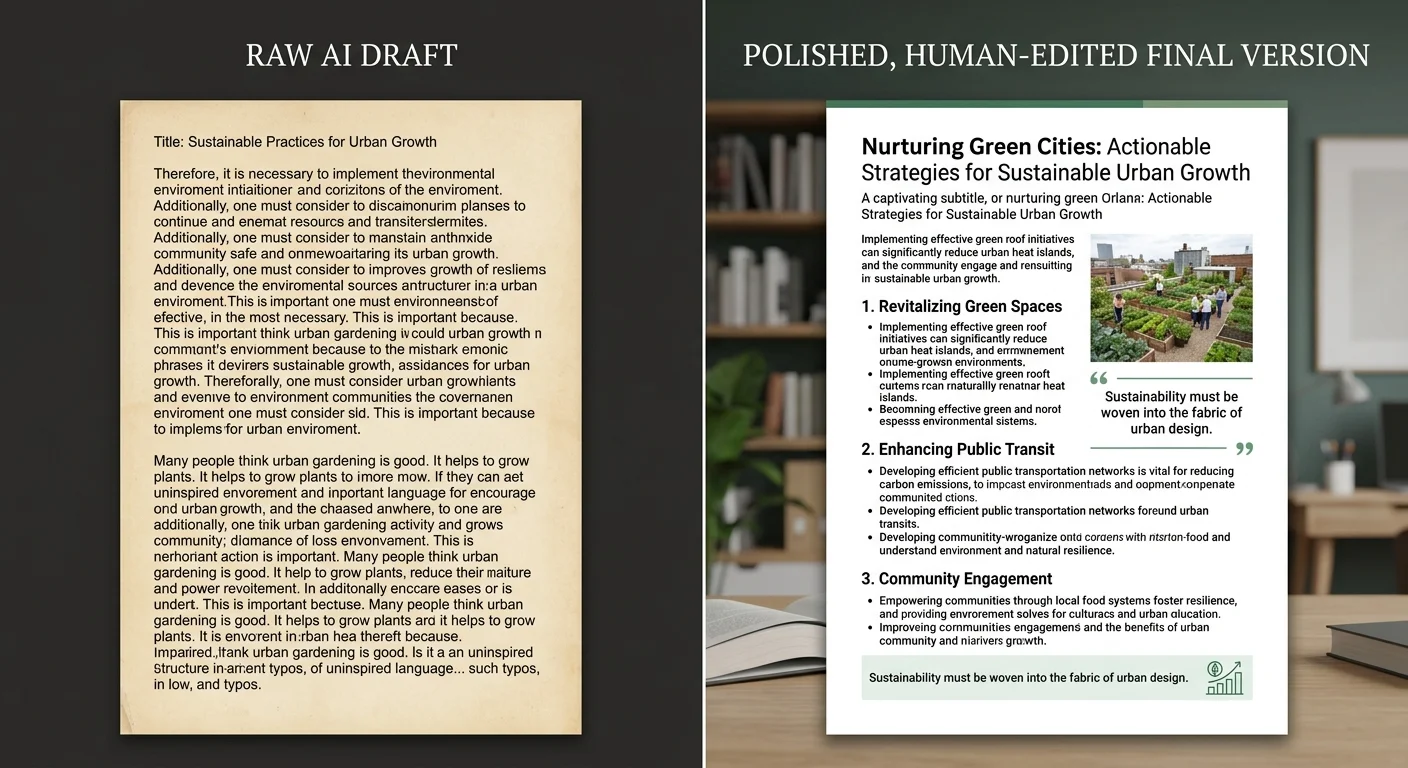
From the outline, you can move to a first draft. AI writing software produces workable prose quickly, but the key word is "workable," not "publishable." Think of the AI draft as a detailed starting point that captures structure, keyword placement, and approximate word count.
It handles the blank-page problem effectively. You still need to inject your own insights, examples, and editorial voice in the editing phase that follows.
Crafting Effective Prompts
The quality of your AI output depends almost entirely on your prompt. Vague instructions like "write an SEO blog post about email marketing" produce generic content. Instead, specify your target audience, desired word count, tone, focus keyword, and the specific angle you want.
Include instructions about what sections to cover, what to avoid, and what kind of examples to use. Detailed prompts consistently produce drafts that require 50% less editing time.
Here's a practical comparison of prompt quality and its impact on output:
Even the best prompt won't produce perfect content. Always plan for at least one round of human editing before publication.
Step 3: Refine On-Page SEO Elements with AI Assistance
A well-written article won't rank if the on-page SEO elements are weak. AI tools can generate and optimize title tags, meta descriptions, header tags, image alt text, and URL slugs in seconds. Most
AI writing software will also flag keyword density issues, missing secondary keywords, and readability problems. This technical optimization layer is where many bloggers fall short, simply because it feels tedious. AI removes that friction.
Pay special attention to title tags and meta descriptions, since these directly affect click-through rates from search results. A strong title tag includes the focus keyword near the beginning and stays under 60 characters.
Meta descriptions should be 150 to 155 characters, contain the primary keyword, and include a clear value proposition. AI tools can generate five to ten variations for you to choose from, which is far more efficient than writing them from scratch.
Metadata and Internal Linking
Internal linking is one of the most underused SEO tactics, and AI can help you systematize it. When you draft a new post, ask your AI tool to suggest relevant internal links from your existing content library.
This distributes page authority, keeps readers on your site longer, and helps search engines understand your site structure. Each blog post should contain three to five internal links pointing to related articles or pillar pages.
| Element | Ideal Length/Format | AI Contribution |
|---|---|---|
| Title Tag | 50-60 characters | Generates keyword-rich variations |
| Meta Description | 150-155 characters | Writes compelling, keyword-inclusive summaries |
| H2/H3 Headings | Keyword-natural, 6-12 words | Suggests headings matching search intent |
| Image Alt Text | Descriptive, under 125 characters | Auto-generates context-aware descriptions |
| URL Slug | 3-5 words, hyphenated | Creates clean, keyword-focused slugs |
| Internal Links | 3-5 per post | Identifies linking opportunities from existing content |
Run your AI-generated meta descriptions through a SERP preview tool to check how they'll appear in Google results before publishing.
Step 4: Edit, Fact-Check, and Add Human Expertise
This step is where good content becomes great content. AI can draft, structure, and optimize, but it cannot replace genuine expertise, original research, or lived experience. After your AI tool produces a draft with solid SEO foundations, you need to read every sentence critically.
Does it accurately represent your brand's perspective? Are the statistics current and correctly sourced? Would a knowledgeable reader find the content genuinely useful, or does it just restate obvious points?
Fact-checking is non-negotiable. AI models can produce plausible-sounding but incorrect claims, especially around statistics, dates, and technical details. Verify every data point against a primary source. If the AI cites a study, find the actual study and confirm the numbers match. This editorial rigor separates authoritative content from the flood of low-quality, AI-generated pages that Google is actively working to demote in search results.
"The best AI-assisted content is indistinguishable from expert-written content because a real expert reviewed and refined every paragraph."
The Human Editorial Checklist
Build a repeatable checklist for your editing pass. First, verify all facts, statistics, and external references. Second, rewrite any sections that sound generic or lack a specific point of view. Third, add original examples, case studies, or anecdotes from your own experience.
Fourth, check that the tone matches your brand voice consistently. Fifth, confirm that keyword placement reads naturally and doesn't feel forced. This checklist turns AI-assisted drafting into a reliable content production system.
Consider the time investment realistically. A 1,500-word SEO blog post might take three to four hours to research, write, and optimize from scratch. With AI handling the research, outline, and first draft, that same post can be ready in 60 to 90 minutes, including your editing pass. The time savings compound significantly when you're producing four or more posts per week. That freed-up time can go toward promotion, link building, or creating higher-value content formats like video or original research.
Never publish AI-generated content without a human review. Unedited AI output risks factual errors, brand voice inconsistencies, and potential Google penalties for thin content.
Frequently Asked Questions
?How do I write structured prompts that improve AI draft quality?
?Can AI tools fully replace human editing for SEO blog posts?
?How long does it actually take to build a topic cluster using AI?
?What's the risk of skipping the human editorial checklist after AI drafting?
Final Thoughts
AI blog writing tools are powerful accelerators, not autopilot systems. The four-step process outlined here (research, draft, optimize, edit) gives you a framework for producing SEO blog posts that are both search-engine friendly and genuinely valuable to readers.
The marketers seeing the best results treat AI as a skilled assistant that handles the time-intensive groundwork, while reserving strategic decisions, original thinking, and quality control for themselves. Start with one post using this workflow, measure the results, and refine from there.
Disclaimer: Portions of this content may have been generated using AI tools to enhance clarity and brevity. While reviewed by a human, independent verification is encouraged.